Quality Custom Book Printing for Authors,Publishers and Creators - SeSe Printing


SESE Printing's Foil Stamping File Requirements: PDF vs. AI Files Explained
SESE Printing's Foil Stamping File Requirements: PDF vs. AI Files Explained
1. Introduction
At Sese Printing, we specialize in transforming ordinary print projects into extraordinary tactile experiences. Whether you're crafting luxury hardcover books, elegant notebooks, premium greeting cards, or custom gift boxes, our foil stamping service adds a touch of sophistication. A common question we receive is: "Can I submit PDF files for foil designs, or are Illustrator (AI) files mandatory?" Let's clarify this while outlining our requirements to ensure your project shines.
2. Accepted File Formats
We accept both PDF and AI files for standard print designs. However, when foil stamping is involved:
General Design Files: PDF or AI formats (300 DPI minimum).
Foil-Specific Layers: While PDFs are accepted, vector-based AI files are strongly recommended for foil layers. This ensures precision in etching the foiling plate, especially critical for intricate designs on covers, spines, or delicate card details.
3. Key Requirements for Foil Stamping & Printing
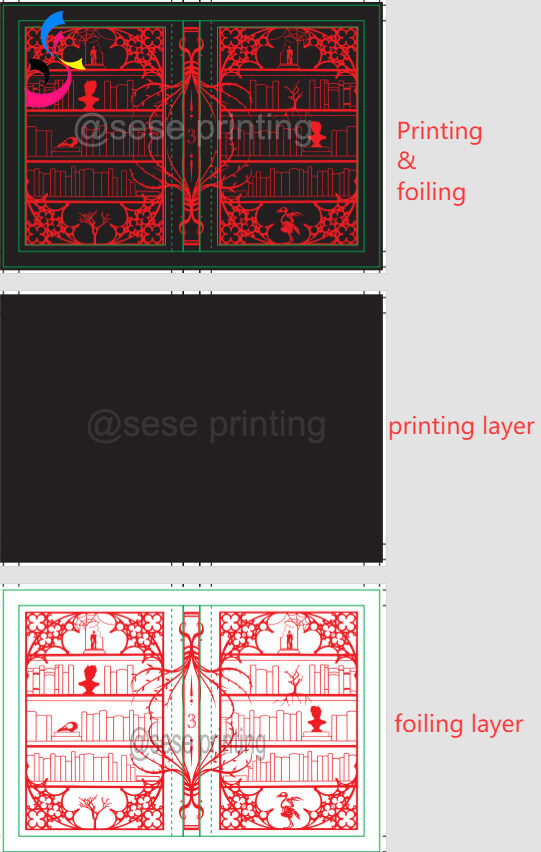
To guarantee flawless results for your books, notebooks, cards, or boxes, adhere to these specifications:
Color & Resolution:
All files must be CMYK (not RGB).
Minimum 300 DPI resolution.
Foil Layer Separation:
Foil elements (e.g., on hardcovers/dust jackets) must be isolated in dedicated layers.
Submit foil layers as vector files (AI) for sharp, scalable results.
Bleed & Safety Margins:
Include 3mm bleed on all sides (interior files).
Extend background designs into the bleed area; keep critical text/elements 5mm from trim edges.
Color Optimization:
For black/gray elements, boost contrast to offset ink absorption on offset paper (prints appear darker).
Binding Readiness:
Page counts must be multiples of 4 (e.g., 32, 100, 208 pages) for seamless binding—no blank pages needed.
4. Pro Tip for Foil Submissions
"When in doubt, choose vectors!"
While PDFs work for base designs, foil layers should always be vector-based (AI). Why?
Prevents fuzzy edges on foil accents (vital for fine text/logos).
Ensures scalability across sizes (e.g., small cards vs. large box lids).
Reduces plate-etching errors.
Our prepress team confirms: Vector submissions accelerate turnaround by 30% for foil projects.
5. Conclusion: Elevate Your Print Projects with Sese
At Sese Printing, we blend technical precision with artistic vision. Our foil stamping expertise—applied to bespoke books, journals, cards, and packaging— guarantees a luxurious finish that captivates. By adhering to these guidelines, you'll not only streamline production but also unlock the full potential of foil's reflective brilliance.
Ready to create something unforgettable? Submit your print-ready files and let Sese Printing turn your vision into a tactile masterpiece.

E-mail: sales01@seseprinting.com
Mobile phone: +86-13570912663
WhatsApp: 008619066781165
Tel: +86-020-34613569
Add: 702 No. 21 Huizhong Road, Shiqiao St, Panyu District. Guangzhou city, Guangdong Province. China