Quality Custom Book Printing for Authors,Publishers and Creators - SeSe Printing


Do You Need an ISBN for Your Book?
Do You Need an ISBN for Your Book?
Publishing a book—whether traditionally or independently—comes with many decisions. One common question authors ask is: Do I need an ISBN for my book? To answer that, let's break down what an ISBN is, why it matters, and whether it's essential for your publishing journey.
1. What Is an ISBN?
An ISBN, which stands for International Standard Book Number, is a unique, machine-readable identification number assigned to every published book and book-like product. Think of it as a digital fingerprint for your book. Each version of your book (e.g., paperback, hardcover, eBook, audiobook) requires its own separate ISBN.
A ISBN is a 13-digit number (as of 2007) that contains information about the book's prefix, registration group (country/region), publisher, title, edition, and format, followed by a check digit.
2. Why Are ISBNs Important?
An ISBN isn't just a random number—it's a critical tool in the publishing industry. Here's why:
Supply Chain Efficiency: Booksellers, libraries, and distributors use ISBNs to track inventory, manage sales, and process orders accurately. Without one, your book is essentially invisible to this system.
Discoverability: Major online retailers like Amazon and Barnes & Noble, as well as library databases, use the ISBN to catalog your book. This makes it easy for readers to find the exact edition they want.
Professionalism: Having an ISBN signals that you are a serious author and that your book is a professionally published product.
Sales Tracking: ISBNs are linked to sales data, which is essential for bestseller lists (like the New York Times or USA Today) and for understanding your market.
3. Do I Need an ISBN?
Whether you need an ISBN depends on your publishing goals. If you want your book available in bookstores, libraries, and online retailers beyond Amazon, you will likely need one. However, if you're distributing privately or only through a platform that doesn't require ISBNs, it may not be necessary.
4. Do Self-Published Authors Need an ISBN?
Self-published authors often wonder if ISBNs are worth the cost. The answer depends on distribution:
Yes, if you plan to sell in bookstores, libraries, or through multiple platforms (IngramSpark, Barnes & Noble, etc.).
No, if you only sell via Amazon Kindle Direct Publishing (KDP), which provides its own identifiers (ASINs for eBooks and free ISBNs for print).
5. Situations Where You Don't Need an ISBN
Not every book project requires one. You may not need an ISBN if you are:
Exclusive Amazon KDP eBooks: If you are publishing an eBook only on Amazon and nowhere else, you can use Amazon's own identification number, the ASIN, instead of an ISBN.
Purely Personal Use: Books printed solely for private distribution (e.g., a family history memoir for relatives).
Books That Are Not for Sale: Certain academic theses or dissertations that are not intended for commercial sale.
Ephemeral Content: Calendars, journals, and coloring books are technically not "books" and do not require an ISBN (though many distributors will require one anyway to list them).
6. How to Get an ISBN
The process varies by country, as there is one official ISBN agency per nation.
In the United States: ISBNs are sold by Bowker, the official U.S. ISBN agency. You can purchase them through myidentifiers.com. They are sold singly, in packs of 10, 100, or 1,000, with significant discounts for bulk purchases.
In Canada: The government provides free ISBNs to Canadian citizens and publishers through the Library and Archives Canada.
In the UK: ISBNs are sold through Nielsen ISBN Store.
Elsewhere: A quick search for "[Your Country] ISBN agency" will direct you to the correct source. Beware of third-party resellers; it's always safest to buy directly from the official national agency.
7. ISBN vs. Other Identifiers
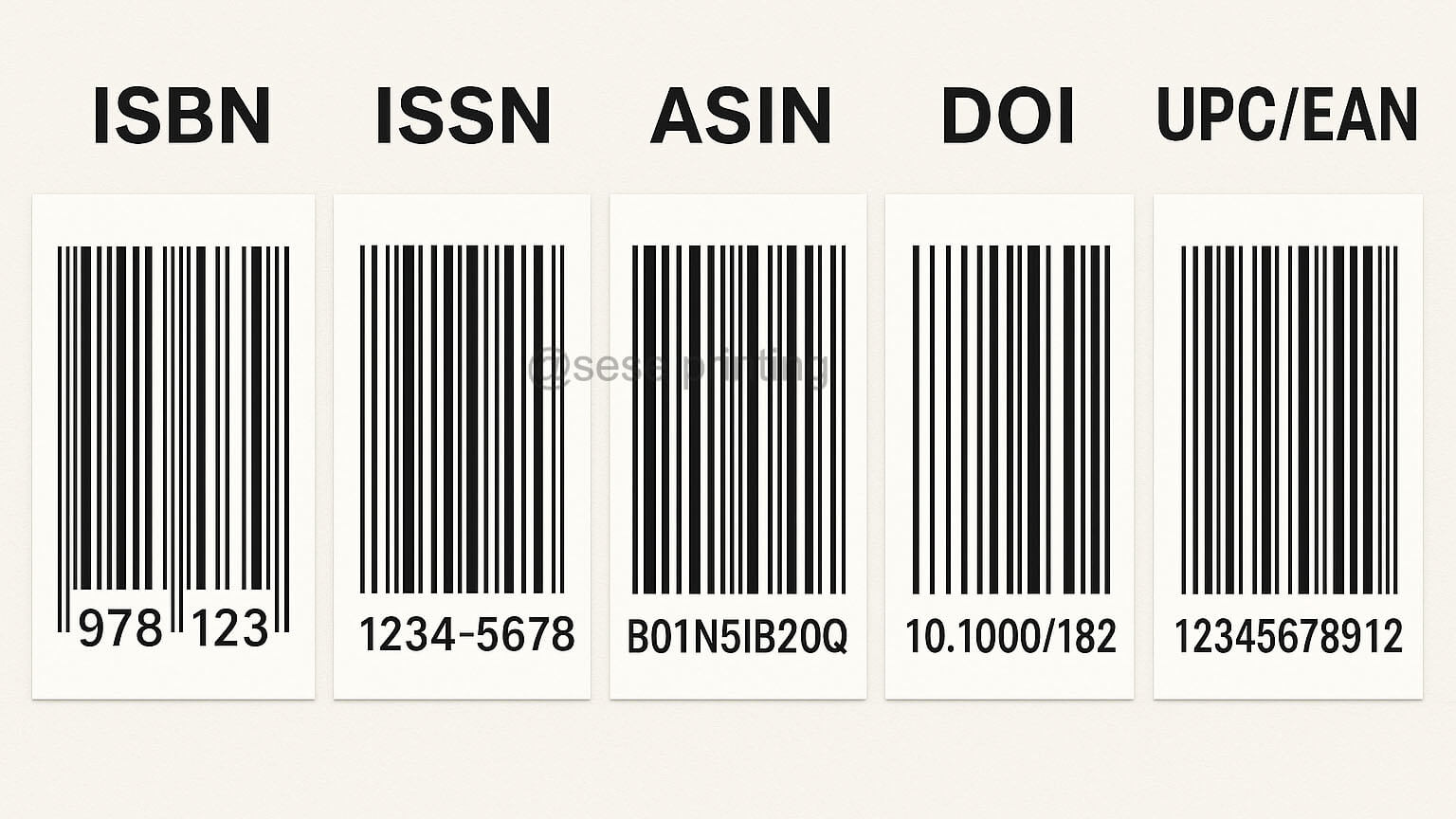
It's easy to get confused by the alphabet soup of identifiers:
ISBN: For books.
ISSN (International Standard Serial Number): For periodical publications like magazines, journals, and newspapers.
ASIN (Amazon Standard Identification Number): Amazon's proprietary identifier used for all products in its catalog, including books. An Amazon eBook will have an ASIN, but if it has an ISBN, that will be displayed too.
DOI (Digital Object Identifier): Often used for journal articles and academic papers to provide a persistent link to their location online.
UPC/EAN Barcodes: Used for retail but often linked to ISBNs for books.
8. Pros and Cons of Having an ISBN
◪ Global distribution and sales reach.
◪ Essential for brick-and-mortar bookstore and library placement.
◪ Significantly improves discoverability and metadata management.
◪ Adds a layer of professionalism and legitimacy.
◪ Cost: ISBNs can be expensive, especially for authors in countries where they are not free.
◪ Administration: Requires managing metadata for each edition.
◪ Not Always Necessary: For authors with a very narrow, direct-sales strategy, it may be an unnecessary expense.
9. Other Things to Consider When Getting an ISBN
One ISBN per Format: Remember, you need a new ISBN for every distinct format. Your paperback, hardcover, eBook (EPUB), and audiobook must each have their own unique number.
Free vs. Paid ISBNs: Some platforms (like Amazon KDP) provide free ISBNs, but they may list the platform as the "publisher." Buying your own gives you full publishing control.
Revisions vs. New Editions: A simple typo correction (a reprint) does not require a new ISBN. However, if you add new chapters, significantly revise content, or change the title, it is considered a new edition and does require a new ISBN.
Barcodes: An ISBN is a number. A barcode is a graphical representation of that number (often with a price appended) that is scanned at checkout. When you buy an ISBN from Bowker, you can usually purchase a barcode image as an add-on. Distributors like IngramSpark will often generate the barcode for you when you set up your title.
Long-term publishing goals: If you plan to expand to bookstores or multiple platforms, owning your ISBNs is a smart investment.
10. Conclusion: Should You Get an ISBN?
In short, an ISBN is not always required—but it's often beneficial. If you only want to publish on Amazon or distribute privately, you can skip it. But if your goal is wide distribution, professional recognition, and long-term publishing control, getting your own ISBN is worth the investment.
Final tip: Think of an ISBN as a passport for your book. For the vast majority of authors seeking a public audience, investing in your own ISBN is a critical step in building a professional and sustainable publishing career. It is the key that unlocks the door to the global book market.

E-mail: sales01@seseprinting.com
Mobile phone: +86-13570912663
WhatsApp: 008619066781165
Tel: +86-020-34613569
Add: 702 No. 21 Huizhong Road, Shiqiao St, Panyu District. Guangzhou city, Guangdong Province. China